
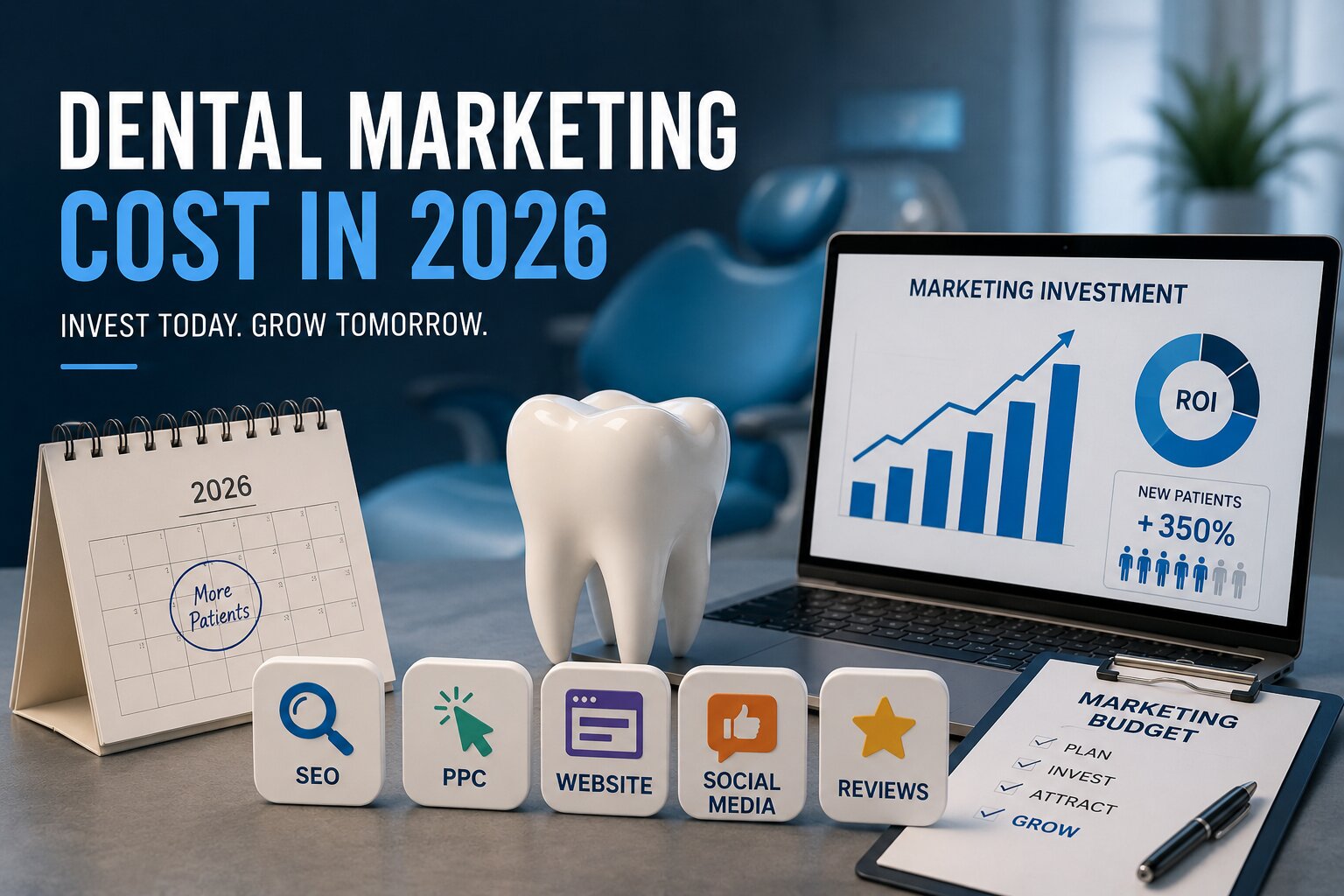
Most dental practices spend somewhere between 4% and 12% of their gross revenue on marketing, with the exact number depending on how competitive their local market is and how aggressively they want to grow. If you’re a solo practitioner in a smaller town, that might mean a few thousand dollars a month. If you’re running a multi-location group in a crowded metro area, it could easily run into five figures. There’s no single “right” number, but there is a right way to think about it and that’s what this guide walks through.
If you’ve ever searched “dental marketing cost” and come away more confused than when you started, you’re not alone. Pricing in this industry is all over the place, partly because “marketing” encompasses so many different things, and partly because agencies price based on scope, market, and the level of hand-holding a practice needs. Let’s break it down by service so you know what you’re actually paying for.
Dental Practice Marketing Budget: How Much Do Practices Typically Spend?
The most common benchmark you’ll hear from consultants and marketing agencies is that dental practices should budget somewhere between 4% and 12% of collections toward marketing. Newer practices, or ones trying to grow aggressively, often sit at the higher end of that range, sometimes even above it for the first year or two while they build a patient base. Established practices with steady referrals and strong reviews can often get away with spending closer to the lower end.
A single-location general practice might land in the $1,500 to $6,000 per month range depending on what’s included. Multi-location groups and DSOs (dental service organizations) tend to spend significantly more in total, but often less per location once campaigns are centralized and systems are shared across sites.
The honest answer to “how much should I spend” is: it depends on your growth goals, your current patient volume, and the level of competition you’re facing in your zip code.
Dental Marketing Pricing by Service
Here’s where it gets more useful. Instead of one number, it helps to look at what each piece typically costs on its own, because most practices don’t need everything at once.
1. Dental SEO Cost
SEO for dental practices usually runs anywhere from $800 to $3,500 per month, depending on how competitive your city is and how much content and technical work is involved. A practice in a small town with little competition might see solid results on the lower end. A practice trying to rank in a major metro area, where twenty other dentists are fighting for the same “dentist near me” search, needs a more aggressive and sustained investment.
What you’re paying for isn’t just “getting on Google.” It’s ongoing work: optimizing your Google Business Profile, building out service pages that actually answer what patients are searching for, earning backlinks, fixing technical issues on your website, and creating content that keeps you relevant. SEO is also the slowest-moving of all these services, so pricing tends to reflect a longer-term commitment rather than a one-time project.
2. Dental PPC Cost (Google Ads)
Paid search is usually priced two ways: a management fee plus your actual ad spend, or a percentage of ad spend (commonly somewhere between 10% and 20%). On top of management fees, most practices spend $1,500 to $5,000 or more per month directly on ads, depending on how competitive their keywords are. Terms like “emergency dentist” or “dental implants near me” can be expensive per click in competitive markets, sometimes running $10 to $50 or more per click for high-value procedures.
PPC is the fastest way to get in front of people actively searching, but it also stops working the moment you stop paying. It’s a good complement to SEO, not a replacement for it.
3. Dental Website Design Cost
A dental-specific website typically costs anywhere from $3,000 for a template-based build to $15,000 or more for a fully custom site with strong conversion design, patient forms, and integrations with your scheduling software. Ongoing hosting and maintenance usually adds another $50 to $300 per month.
This is one area where cutting corners tends to backfire. A slow, outdated, or hard-to-navigate website undermines every other marketing dollar you spend, because paid traffic and organic rankings are only valuable if visitors actually convert into booked appointments once they land there.
4. Social Media Management Pricing
Ongoing social media management for a dental practice generally runs $500 to $2,500 per month, depending on how many platforms you’re active on and whether that includes paid social ads on top of organic content. This tends to be more of a brand-building and retention tool than a direct lead-generation channel, though it can absolutely support both when done well.
5. Reputation and Review Management Pricing
Review and reputation management services typically cost $200 to $800 per month. Given that online reviews are often the single biggest factor in whether a new patient chooses your practice over the one down the street, this is one of the higher-ROI, lower-cost pieces of the puzzle, and one that’s easy to underestimate.
What Factors Affect Dental Marketing Cost?
A few things consistently move the needle on pricing:
- Market competitiveness. A practice in a dense city with dozens of competing dentists needs a bigger budget to stand out than a practice in a smaller town with little competition.
- Number of locations. DSOs and multi-location practices often get better per-location rates once campaigns and systems are shared, but the total spend is naturally higher.
- Scope of services. A practice that only wants SEO will pay differently than one that wants a full-funnel approach covering SEO, website development, social media marketing for dentists and reputation management together.
- Agency specialization. Agencies that focus specifically on dental marketing often charge more than generalist agencies, but they also tend to understand patient acquisition costs, procedure-specific keywords, and compliance considerations that generalist agencies miss.
Pricing Models Explained: Retainer vs. Percentage of Ad Spend vs. Project-Based
Most dental marketing pricing falls into one of three structures.
- Flat monthly retainer is the most common model, especially for SEO, social media, and reputation management. You pay a set fee each month regardless of results that month, which makes budgeting predictable but means you’re trusting the agency’s process rather than paying per outcome.
- Percentage of ad spend is standard for PPC management. The agency’s fee scales with how much you’re spending on ads, which aligns their incentive with growing your campaigns, though it’s worth asking whether that incentive sometimes pushes spend higher than necessary.
- Project-based pricing applies mostly to one-time work like website builds or a specific campaign. You pay for a defined deliverable rather than an ongoing relationship, which works well when you know exactly what you need but less well for services that require continuous optimization.
None of these is inherently better. The right model depends on what you’re buying and how much you want predictability versus flexibility.
Is Dental Marketing Worth the Cost?

The math usually works in your favor when you zoom out. A single new patient’s lifetime value, once you factor in cleanings, treatments, referrals, and family members who often follow, frequently reaches into the thousands of dollars over several years. Even a $300 acquisition cost looks reasonable against that backdrop.
Where marketing stops being worth it is when the strategy is scattered: a little bit of everything with no clear system tying it together, no tracking of where patients actually come from, and no follow-through on the leads that do come in. The spend itself rarely wastes money. Poor execution and poor tracking do.
How to Set Your Dental Practice Marketing Budget for 2026
One of the biggest mistakes dental practices make is treating marketing as an expense rather than an investment in patient acquisition. Many clinics either underinvest and struggle to attract new patients or overspend on channels that don’t generate measurable results. The key is not asking, “How much should we spend on marketing?” but rather, “How much growth do we want to achieve?”
A practical way to approach your dental practice marketing budget is to work backward from your goals. For example, if your clinic wants to attract 30 new patients each month, you need to estimate how many leads, website visitors, and marketing activities are required to reach that target.
Most growing dental practices allocate around 4% to 12% of annual revenue toward marketing, while newer or expansion-focused clinics may invest more to increase visibility and compete in local markets.
Your budget should typically be divided across the channels that directly influence patient decisions:
- Dental SEO and local SEO: Improve your visibility in Google Search and Google Maps.
- Social Media Marketing for Dentists : Build trust and engage prospective patients.
- Dental website design and optimization: Convert visitors into appointments.
- Paid advertising: Generate immediate leads for high-value treatments.
- Content marketing and patient education: Strengthen authority and support long-term growth.
However, not every channel deserves the same investment. For example, if most of your patients discover your clinic through search engines, investing in dental SEO services and local SEO for dentists may deliver a higher return than spending heavily on traditional advertising.
The most successful dental practices treat marketing as an ongoing growth strategy rather than a one-time expense. By investing in the right mix of dental digital marketing, social media, SEO, and website optimization, clinics can create a predictable system for attracting patients and achieving sustainable practice growth.
How Successlytics Helps Dental Practices Grow Through Dental Marketing
Knowing the numbers is one thing. Turning them into a full schedule is another. The practices that get the most out of their marketing budget aren’t necessarily spending more, they’re working with someone who already knows what converts in dentistry specifically, so every dollar is doing something useful from month one instead of funding a learning curve.
That’s the gap Successlytics is built to close. Rather than treating dental practices like any other local business, we focus specifically on how patients search for and choose a dentist, from the first “dentist near me” search to the moment they actually book. That means SEO built around the procedures that matter most to your bottom line, PPC campaigns that target patients ready to schedule rather than just browsing, and websites designed to convert visits into appointments instead of just looking polished.
We also believe practices deserve to know where their money is going. Instead of vague monthly reports, we track what actually matters: cost per new patient, where your leads are coming from, and which channels are worth scaling versus cutting. If a campaign isn’t performing, we adjust it. If something’s working, we double down on it.
Ready to attract more patients? Get in touch with Successlytics today for a free consultation and discover how our customized dental marketing solutions can help your dental practice grow.

Frequently Asked Questions
How much does dental marketing cost per month?
Most single-location practices spend between $1,500 and $6,000 per month total across services like SEO, PPC, and website maintenance though this varies based on market competitiveness and growth goals.
What percentage of revenue should a dental practice spend on marketing?
A common benchmark is 3% to 8% of gross revenue, with newer or growth-focused practices often spending toward the higher end.
Is dental SEO worth the cost?
For most practices, yes. SEO tends to deliver more sustainable, lower-cost-per-patient results over time than PPC, which delivers faster visibility but stops working the moment you stop paying. Most practices get the best return by using both together rather than choosing one.
How much does a dental website cost?
A professional dental website typically costs $3,000 to $15,000 depending on customization, with ongoing hosting and maintenance adding $50 to $300 per month.
How long before dental marketing shows ROI?
PPC can show results within weeks. SEO typically takes four to six months to build meaningful traction, though the results tend to compound and last longer once established.
How much does a dental marketing agency charge?
It depends on the pricing model. SEO, social, and reputation management are usually billed as flat monthly retainers, while PPC management is commonly priced as a percentage of ad spend, often 10% to 20%.